
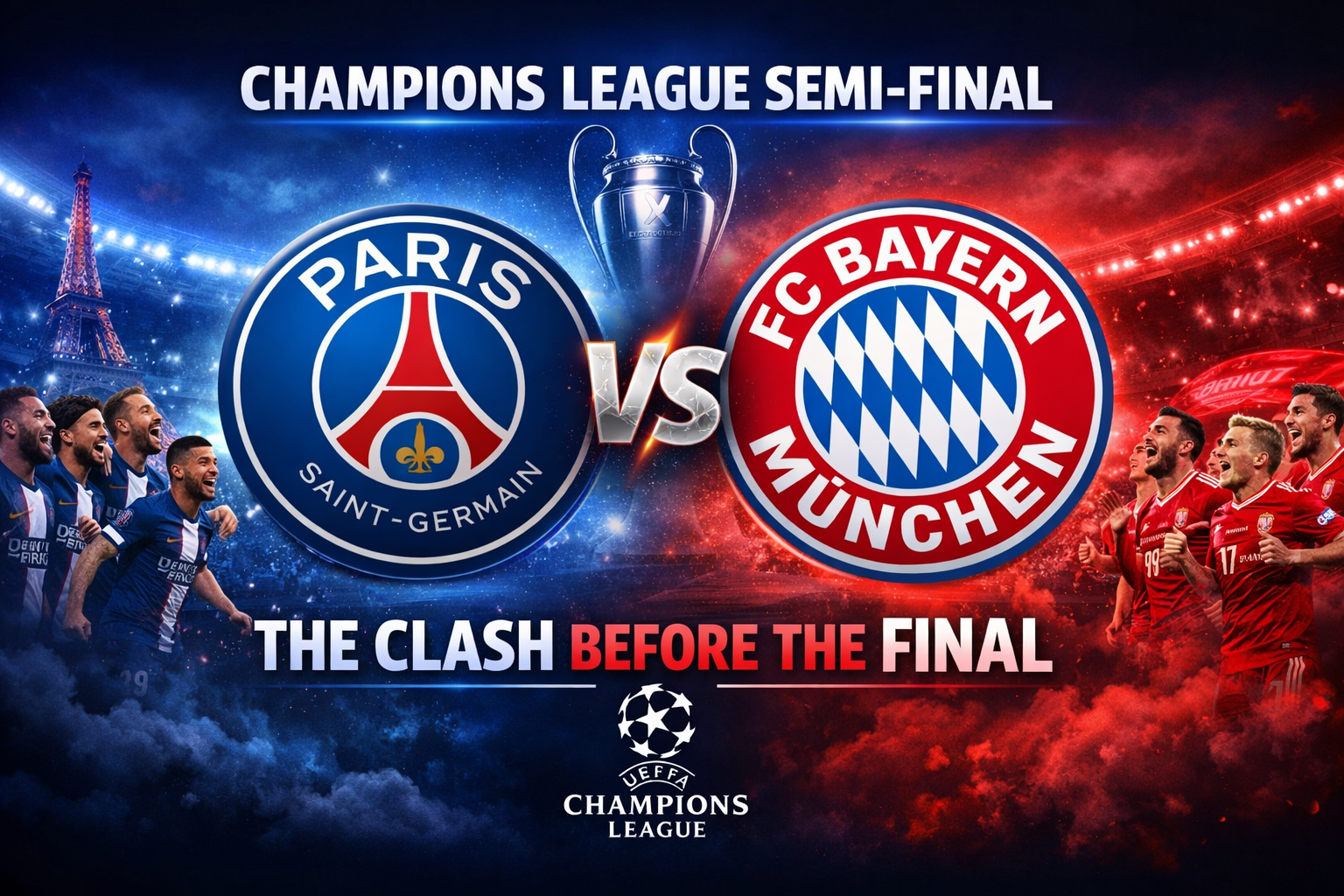
In this season’s UEFA Champions League, the tie between Paris Saint-Germain and Bayern Munich isn’t merely another semi-final, it embodies a collision of footballing identities and continental ambition, a duel between the reigning champions and the perennial German powerhouse that has rarely looked more complete. The French media and the European analysts have gone to the extent of calling this clash the de facto final, owing to its high calibre and tension-filled storylines.
The Broader Context: Stakes Beyond a Trophy
Champions League campaign this season for PSG is an opportunity to retain the title they fought for last season. Getting to the semi-final as back-to-back finalists is a rare achievement in modern European football. PSG have stitched together consistent attacking brilliance with tactical flexibility throughout the tournament. They have already defeated two Premier League giants, Chelsea in the Round of 16 and Liverpool in the quarter finals, PSG moved with decisive strikes that underscored their knack for big-match temperament.

The German side have been providing an exciting brand of football under the management of Vincent Kompany. Their quarter-final victory over Real Madrid, a 4-3 thriller that secured a 6-4 aggregate, displayed not just their scoring prowess but their capacity to withstand pressure and adapt tactically even at the face of match-threatening moments.
This will set up an exciting semi-final that is full of drama, as PSG will try to protect their crown and create history, while Bayern will try to re-establish themselves as a team that can succeed on the European stage.
Historical Backdrop & Psychological Dynamics
Football history hardly lies, and here, it is further complicated by psychology. In most competitive matches played between the two teams in Europe, Bayern Munich is undoubtedly better than PSG, having won more of the matches against them in recent years. Bayern Munich has beaten Paris in all of their last five matches in the Champions League, which makes life difficult for any coach or player who plays in this match.
Though PSG managed to emerge victorious against Bayern Munich in the Club World Cup last year, the history of success remains in favor of the Bavarians in the most prestigious club competition in the world.
Tactical Philosophy: Understanding Playing Styles
For PSG, the essence of their game for the current season lies in attacking movement and positional interplay. Their attacking lineup includes Khvicha Kvaratskhelia, Ousmane Dembélé, and promising talents such as João Neves who is good at drawing out opposing defenders and playing through half-spaces with quick, vertical balls, the results of these tactics are evident from their numbers in the Champions League, where PSG has been averaging almost 2.7 goals per game.
But it is a two-way attacking canvas for them. Even as Paris Saint Germain create goal-scoring opportunities very easily, the team’s defensive statistics show that they concede many more goals than Bayern. In closely contested matches, even a small slip-up might mean conceding vital chances.
While the tactics of Bayern Munich are based on structure balance, this is achieved by playing out of a structured formation of 4-2-3-1 most of the time. They quickly shift from defending to attacking when they possess the ball, and their midfield playmakers don’t only retain possession but break the rhythm of the opponents’ team while pushing the ball up the pitch for the attackers to score, such as Harry Kane, who scored a number of goals for his team during the quarter-finals.
This tactical contrasting of PSG’s expansive, vertical movement versus Bayern’s calculated transitional play ensures the first leg’s strategic battle will set the tone for the tie’s narrative.
Key Player Matchups That Could Define the Tie
It is possible to predict how the match will proceed by considering particular battles. On the offensive side for PSG, unpredictable players like Kvaratskhelia and Dembélé will definitely try to disrupt any organized defence from Bayern Munich defense. The duo’s skills will be put to the test against Bayern’s solid defence, who always defend higher during matches they control.
On the other hand, Bayern’s strength in depth and multi-layered midfield offers a measure that can neutralize PSG’s creative outlets, the double pivot designed to break up play and push forward quickly will be a thorn in PSG’s half if executed with precision and discipline.
On defense, the clash of Bayern’s central defenders against PSG’s strikers may prove to be crucial. The Bavarian defense needs to keep an eye on the constantly shifting roles of the attacking players from Paris Saint-Germain, especially in situations where the French side quickly shifts the ball from one flank to another. In return, Bayern’s swift transition game, aided by Kane’s brilliant movement and scoring touch, may make PSG pay.
What This Tie Ultimately Represents
The semi-final pits two competing football philosophies against each other, the attacking prowess of PSG against the tactical brilliance of Bayern Munich. It is in all these subtleties that the narrative of both legs is going to be written.
The impending battles at the Parc des Princes and later at the Allianz Arena don’t just test tactics and talent; they probe psychological seriousness. PSG seeks to defend the most prestigious trophy in Europe, whereas Bayern seek to reclaim their rightful place in the history books as European champions. In this duel of football identity and ambition, the smallest tactical adjustment or individual moment of brilliance could define which side walks into the final as contender and which exits with lessons for the future.
[4785]ace67 Official Login | সেরা অনলাইন ক্যাসিনো ও দ্রুত বিকাশ পেমেন্ট,ace67-এ আজই যোগ দিন। আমাদের অ্যাপটি ডাউনলোড করে সেরা স্লট গেমের নিয়ম জানুন এবং বিকাশ পেমেন্টের মাধ্যমে দ্রুত লেনদেন শুরু করুন। এখনই ভিজিট করুন। visit: ace67
[8580]ok333 Official Login | সেরা অনলাইন ক্যাসিনো ও স্লট গেম,ok333 অফিসিয়াল লগইন করে সেরা অনলাইন ক্যাসিনো গেম উপভোগ করুন। বিকাশ দিয়ে টাকা ডিপোজিট এবং অ্যাপ ডাউনলোড করে আজই স্লট গেম খেলা শুরু করুন। visit: ok333
[4846]betjee Official Login | বিকাশ পেমেন্ট অনলাইন ক্যাসিনো বোনাস,betjee অ্যাপ ডাউনলোড করে সেরা অনলাইন স্লট গেমের নিয়ম জানুন। বিকাশ পেমেন্টের মাধ্যমে দ্রুত লেনদেন করে আজই আপনার যাত্রা শুরু করুন। visit: betjee
I’ve recommended this to a few friends already because the graphics are stunning and the gameplay is fair. You guys should try sixgameonline now!
Finally a platform that doesn’t lag during big wins. Very reliable and easy to navigate. Get started with phcash11comlogin right now.
The VIP treatment here is actually real. I feel valued as a player and the exclusive perks are a nice touch. krvip is definitely the way to go.
Solid platform with a great selection of slots. I had a lucky streak yesterday and the withdrawal was processed in no time. Love vnnl88.